September 15, 2026
Why Digital Formboards Are the Future of Wire Harness Manufacturing
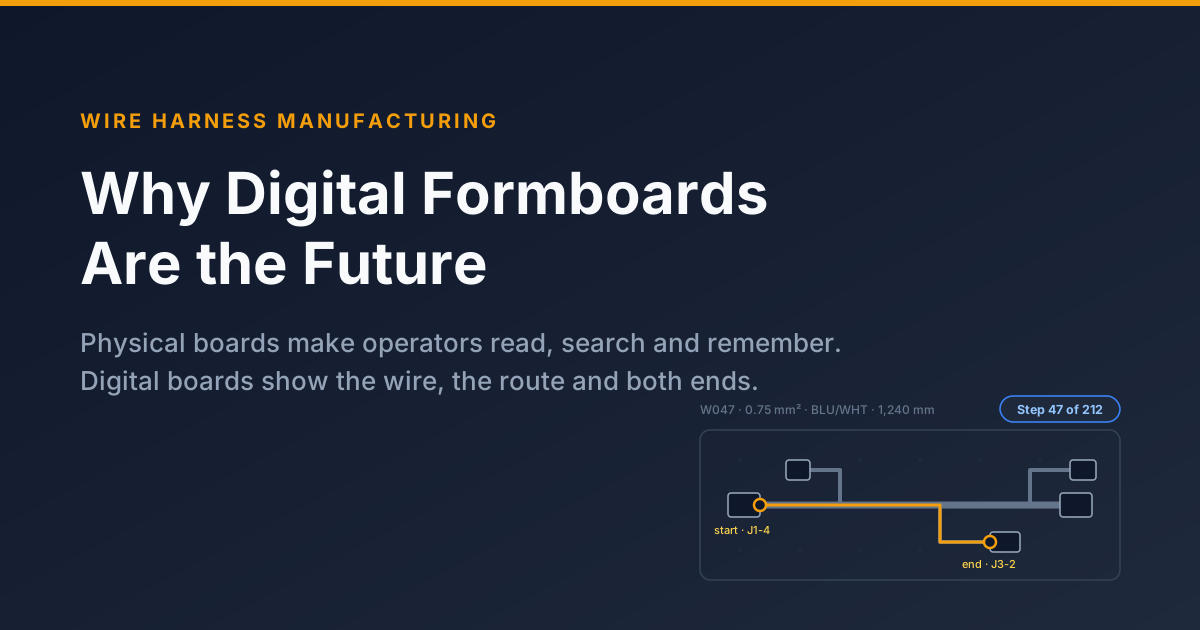
Physical formboards make operators read, search and remember. Digital formboards show the wire, route and both ends per step. What changes, with evidence.
By Harnessora
Why Digital Formboards Are the Future of Wire Harness Manufacturing
Watch an experienced operator build a harness on a physical formboard and the work looks fluent. Watch a new operator do the same job and you see what the experienced one has learned to hide: read the drawing, find the wire, find where it starts, trace the route, find where it ends, check it, next wire. Repeat two hundred times.
Every step in that loop except the routing itself is searching. Search is where the time goes, search is what takes years to get fast at, and search is where errors are born. A digital formboard exists to remove the searching. That is the whole case for it, and the evidence behind it is stronger than most people in the industry realise.
Key Takeaways
- On a physical formboard, most of the operator’s effort is finding — the wire, the start point, the route, the end point — not placing. Older time studies put wire routing at up to 50% of harness standard time.
- Co-locating the instruction with the work is what pays off. A controlled study of 75 participants found spatially registered instructions cut assembly errors by 82% versus a printed manual and lowered measured mental workload (Tang et al., CHI 2003).
- Boeing’s harness-specific pilot reported 25% shorter assembly time and error rates halved; a related Boeing/Iowa State study found ~30% faster assembly and ~90% better first-time quality than desktop PDF instructions.
- Novices benefit most: animated guidance shortened the learning curve of new assemblers in a 50-participant study (Hou et al., 2013).
- How the guidance is drawn matters. In a 2026 formboard study, showing the whole wire route at once was 18% faster than flashing or segmented displays, with the fewest gaze switches.
How a Traditional Formboard Actually Works
A formboard is a flat board — plywood, pegboard or a purpose-built panel — carrying a full-scale drawing of the harness. Fixtures are mounted on it: nails or pins at branch points, U-shaped clips along the trunk, connector holders at each end. The operator lays wires along the drawn paths, inserts terminals into connector cavities, bundles the trunk with tape, sleeving or ties, and adds clips and labels until the harness on the board matches the drawing under it.
It is the main step of the process. A 2019 state-of-the-art review of automotive harness production describes assembly on the board as “the most important and labor-intensive part of the wire harness manufacturing process,” and notes that while pre-production — cutting, stripping, sealing, crimping — is well automated, “almost all work steps at the assembly line are executed manually” (Trommnau et al., Procedia CIRP 81, 2019).
The method works. It is cheap, it is flexible, and every harness shop in the world knows how to run it. But look closely at what the operator does for each wire:
- Read the drawing or wire list to identify the next wire — by circuit number, colour, gauge and length.
- Find that wire in the kit or on the rack.
- Find the start point on the board — which connector, which cavity.
- Route the wire along the drawn path, through the correct clips and around the correct pins.
- Find the end point — which connector, which cavity.
- Verify the placement against the drawing, then go back to step 1.
Four of the six steps are search. The routing — the only step that adds anything to the product — sits in the middle of them.
Where the time goes
The best available time-share data is old, and the authors of the 2019 review say so plainly: studies from the 1980s and 1990s put wire routing at up to 50% of harness standard time, wire preparation at up to 38% and bundling at up to 30%, and “no current data is publicly available” (Trommnau et al., 2019). Take the exact figures loosely. The shape is not in doubt: the board is where the hours are, and routing is the biggest single slice.
Inside that slice, the time an operator spends physically placing a wire is small. The time spent looking — at the drawing, at the rack, at the board, back at the drawing — is not.
Why it depends on experience
An experienced operator does not read the board; they recognise it. After enough builds, the sequence is memorised, the connector positions are known by feel, and the drawing becomes a reference for exceptions rather than a guide for every step. That is genuine skill, and it takes months to develop.
It also means the process’s speed lives in people rather than in the process. A new operator on the same board with the same drawing is doing visual search for every wire, and visual search is the weakest part of human performance. Research on inspection summarised by Sandia National Laboratories notes that humans “perform relatively more poorly during the search portion” of a visual task, and describes the failure mode as “looking but not seeing” (See et al., Sandia National Laboratories).
Why errors happen
The specific mechanism is attention switching. Every time the operator looks from drawing to board and back, they have to carry the wire identity, the start cavity, the route and the end cavity in short-term memory across the switch. A foundational CHI study of instruction media put it precisely: “when transferring attention back and forth between instructions and the locus of the action, the user must keep the operation, location, and orientation of the part in memory” (Tang, Owen, Biocca and Mou, CHI 2003).
Drop one of those items during the switch and the result is a wire in the wrong cavity, a missed branch, a route on the wrong side of a pin — and, because harness assembly is cumulative, an error that the next several wires are built on top of. Add the revision problem: on a paper-driven board, the drawing clipped to the board is the drawing the operator uses, whether or not engineering released a newer one last week.
What a Digital Formboard Changes
A digital formboard keeps the board — the fixtures, the pins, the clips — and replaces the paper. The harness layout is held as data, and instructions are delivered to the operator at the point of work: on a screen mounted at the board, projected directly onto the board surface, or through a headset. The delivery method matters less than what is shown.
For each step, the operator sees:
- The wire — circuit ID, colour, gauge, length, and where to pick it from
- The route — the path highlighted on the board layout, with the clips and pins it passes
- The start point and end point — which connector, which cavity, at both ends
- The connector locations on the board
- The sequence — this step, then the next, in an order engineering has defined rather than one the operator has to work out
- Inspection points where they apply — a check to confirm before the next step appears
The operator confirms the step, and the next one appears. The four search steps in the loop above collapse into one: look at the board, where the instruction already is.
The confirmation is also a record. Who built this harness, in what sequence, with which wire lot, and how long each step took is captured as a by-product of building it. On a paper board, that information does not exist.
How the guidance is drawn matters
Not all digital guidance is equal. A 2026 controlled study — one of the very few run on an actual wire harness formboard task — compared three ways of visualising a wire path in monitor-based AR guidance: a static display of the whole route, a dynamic display that flashed, and a dynamic display revealing the route in segments. The static full-route display was 18% faster, with the fewest gaze switches between screen and board and the shortest total fixation time. Error counts and perceived workload did not differ between modes (Wang, Zhan, Zou, Lin and Wu, Behavioral Sciences 16(7), 2026).
The authors note this contradicts findings from general mechanical assembly, where animated guidance often wins. On a formboard, the operator needs to see the whole path before committing the wire. The practical lesson for anyone specifying a system: show the route, not a cartoon of the route, and minimise the number of times the operator has to look away from the board.
What the Evidence Says
The research on guided, co-located instructions goes back more than two decades and is consistent.
The mechanism study. Tang, Owen, Biocca and Mou ran a between-subjects experiment with 75 participants and four instruction media: a printed manual, computer instructions on a monitor, the same instructions on a head-mounted display, and spatially registered AR overlaid on the parts. The AR condition “reduced the error rate for an assembly task by 82%, particularly diminishing cumulative errors,” and measured mental effort was lower — “suggesting some of the mental calculation of the assembly task is offloaded to the system” (CHI 2003). Note that the head-mounted display without spatial registration did not achieve this. The gain comes from putting the instruction where the work is, not from the hardware.
The training study. Hou, Wang, Bernold and Love compared an animated AR system to a paper manual across two experiments with 50 participants. The AR system produced shorter completion times, fewer errors and lower total task load, and “the learning curve of novice assemblers was reduced” (Journal of Computing in Civil Engineering 27(5), 2013).
The harness-specific pilot. Boeing ran smart-glasses guidance with around 20 wire harness technicians between March and November 2015. Assembly time fell 25% and error rates were “chopped in half,” against a baseline of PDF instructions on laptops (CIO, 2016). A controlled Boeing/Iowa State study on a 50-step assembly reported around 30% faster completion and “an almost 90% improvement in first time quality” for guided AR over desktop PDF, with the AR group averaging zero errors (AREA, 2015).
None of these is a large industrial trial of a projected formboard in a high-mix harness plant, and the exact percentages will not transfer to your floor. What transfers is the direction, the size, and the consistency: every controlled comparison finds the same thing, for the same reason. If you want the history — the term “augmented reality” was coined at Boeing in 1990 for exactly this job — it is covered in our overview of harness digitalisation.
The Value for Operators
The operator is the person the digital formboard is actually for, and the benefits are concrete.
Easier training. A new operator no longer has to learn to read a board before they can build on it. The system carries the sequence; the operator supplies the hands. The learning curve reduction in the Hou et al. study is the measured version of what every supervisor has seen — the gap between a first-week operator and a first-year operator is mostly search speed, and guidance closes it.
Reduced searching. The wire, its start, its route and its end are shown. The four search steps become one glance.
Less cognitive load. Nothing has to be carried across an attention switch, because there is no attention switch. The lower NASA-TLX scores in both the Tang and Hou studies are this effect, measured.
Faster work. With search removed, the operator’s time converges on the routing itself. The 25–30% time reductions in the Boeing trials are consistent with that.
Higher confidence. The operator knows the step is right before moving on, because the system confirmed it. On complex harnesses — hundreds of wires, dozens of connectors, several revisions live at once — that confidence is the difference between an operator who builds and an operator who hesitates.
The Value for the Company
Each operator benefit has a company-side mirror, and several of them compound.
| Operator benefit | Company benefit |
|---|---|
| Less searching, faster placement | Higher productivity; shorter assembly time per harness |
| Fewer errors at the step | Better quality, fewer defects, less rework and scrap |
| Faster to competence | Faster onboarding; less dependence on a small pool of experienced operators |
| Same instruction for everyone | Standardised process across operators, shifts and sites |
| Always on the released revision | Real change control; no obsolete drawing on the board |
| Every step confirmed | Traceability — who, what, when, which lot — for audits, customer requirements and containment |
| Confident work on complex builds | Predictable throughput; fewer delivery surprises |
Two of these deserve emphasis.
Traceability is moving from nice-to-have to required. The same review that documented how manual the board still is also observed that current trends “will require more documentation, traceability and monitoring of the production process” (Trommnau et al., 2019). A digital formboard produces that record without a single extra clerical step. A paper board cannot produce it at all.
Lower manufacturing cost is the sum of the rest: fewer labour-hours per harness, less rework, faster onboarding, less scrap, and fewer quality escapes reaching the customer. The board is the largest manual cost centre in the process. A digital formboard is the most direct way to reduce it without automating the routing itself — which, as the 2019 review notes, the industry has been trying and failing to do since the 1980s.
What to Get Right
A digital formboard is only as good as three things.
The master data. The layout, wire list and sequence come from engineering. If the wire list is wrong, the digital board will guide the operator to build the wrong harness with great precision. Get the data path from design to board clean first — ideally the same data that priced the job.
The sequence and the visualisation. Engineering has to define a build order, which most paper processes never formalised. And the 2026 formboard study is a warning against flashy guidance: show the whole route, minimise gaze switches, and test with real operators before rolling out.
The standard. Guidance tells the operator what to do. It does not define what an acceptable result looks like — that is still IPC/WHMA-A-620 and the terminal manufacturer’s application specification, and crimp height and pull force are still measured, not displayed.
Conclusion
Wire harness manufacturing has automated everything around the board and almost nothing on it. The board is where the labour is, where the skill is, where the errors are, and where the industry’s productivity has been stuck for forty years — because the operator’s job there has always been mostly looking.
A digital formboard does not change what the operator’s hands do. It changes what their eyes and memory have to do, and that turns out to be most of the job. The evidence — from a 2003 lab study to Boeing’s harness floor to a 2026 formboard experiment — says the same thing every time: put the instruction where the work is, and time, errors and cognitive load all drop, with the largest gains going to the people with the least experience.
That is why digital formboards are the future of this industry. Not because they are new, but because they fix the oldest problem on the floor, and they leave a record behind while doing it.
If you run a harness line: how long does it take a new operator to reach the speed of your best one — and how much of that gap is searching?
Frequently Asked Questions
What is a digital formboard?
A digital formboard keeps the physical assembly board and its fixtures but replaces the paper drawing and work instructions with data-driven, step-by-step guidance delivered at the board — on a screen, projected onto the surface, or through a headset. For each step it shows the wire, the route, the start and end cavities, the connector locations and the sequence, and it records the operator’s confirmation.
Do digital formboards actually reduce errors?
Controlled studies say yes. A 75-participant CHI study found spatially registered instructions cut assembly errors by 82% versus a printed manual (Tang et al., 2003). Boeing’s wire harness pilot reported error rates roughly halved (CIO, 2016). The common mechanism is removing the attention switch between drawing and board, which is where cumulative errors start.
Why do new operators benefit most?
Because the gap between a new and an experienced operator on a physical board is mostly search speed — recognising the layout, remembering the sequence, finding cavities. Guidance removes that search, so novices approach experienced speed sooner. A 50-participant study found animated guidance shortened the learning curve of novice assemblers (Hou et al., 2013).
Does a digital formboard replace physical fixtures or the workmanship standard?
No to both. The pins, clips and connector holders stay; only the paper goes. And guided instructions say what to do, not what an acceptable result looks like — IPC/WHMA-A-620, the terminal application specification, and crimp process controls still apply.
What is the biggest implementation risk?
Bad master data. The board guides the operator with whatever wire list and sequence it is given. Clean the data path from engineering to the board before rolling out, and test the visualisation with real operators — a 2026 formboard study found that a static full-route display outperformed flashing and segmented displays by 18% on task time.
Sources
- Trommnau, J., Kühnle, J., Siegert, J., Inderka, R., Bauernhansl, T. — Overview of the State of the Art in the Production Process of Automotive Wire Harnesses, Current Research and Future Trends, Procedia CIRP 81 (2019) 387–392 — manual share of board assembly, time-share data and its caveats, traceability drivers. Open access.
- Tang, A., Owen, C., Biocca, F., Mou, W. — Comparative Effectiveness of Augmented Reality in Object Assembly, Proceedings of CHI 2003, pp. 73–80 — 82% error reduction, mental workload, attention-switching mechanism.
- Hou, L., Wang, X., Bernold, L., Love, P. E. D. — Using Animated Augmented Reality to Cognitively Guide Assembly, Journal of Computing in Civil Engineering 27(5) (2013) 439–451 — novice learning curve, task load.
- Wang, J., Zhan, J., Zou, Q., Lin, Y., Wu, L. — Investigating the Impact of Augmented Reality Instruction Modes for Manual Wire Harness Assembly Task on Formboards, Behavioral Sciences 16(7) (2026) 1066 — formboard-specific visualisation modes, eye-tracking, task time. Open access.
- See, J. E., Drury, C. G., Speed, A., Williams, A., Khalandi, N. — The Role of Visual Inspection in the 21st Century, Sandia National Laboratories — human performance in visual search.
- Sacco, A. — Google Glass takes flight at Boeing, CIO, 13 July 2016 — wire harness pilot results.
- AREA — Augmented Reality Can Increase Productivity, 20 August 2015 — Boeing/Iowa State study results.
Study figures are as reported by the named sources. They come from laboratory experiments and pilots of varying scale and should be read as evidence of mechanism and direction, not as guaranteed outcomes for any particular harness operation.
See Harnessora on your own harness
One drawing generates the digital work instructions, the instant quote, the BOM, the formboard, and the wire cut list.
Request a demo